idk, try it
When trying things is free, something clicks. A story about rediscovering the joy of just shipping code.

There’s a feeling you get when you’re hacking on something with friends and the tooling just gets out of the way. You make a change, you ship it, you see what happens. “Like this?” “No, like that!” “OMG yeah!” It’s pure feedback loop. It’s play.
Lately I’ve been getting that feeling from a little internal project called Mirener. It started as a Google Meet bot but has slowly grown into… I don’t know, a general-purpose ambient software thingy? Our little Slack buddy that does whatever we need it to do this week.
A Bot is Born
Back in August, we wanted something simple: type /meet in Slack, get a Google Meet link. There were a couple of integrations in the Slack marketplace, but none of them felt quite right. You couldn’t customize the notifications. They didn’t work in threads. You couldn’t tell if anybody was actually in the meeting or not. Auto-transcripts and summaries were a new feature, but they’d get lost in permissions vortexes.
Evan, as he often does, said something like “surely we can do better by writing a little software.” In no time he had something basic up and running. A few days later, voila — meeting notes posted back to the channel automatically. Already better than anything we’d found in the marketplace.
Then he did another Evan thing: “Hey, anybody should feel free to add stuff to this.”
Jumping In
So I started poking at it. I wanted to add thread support so you could @mirener meet in any conversation.
I got something half-working and hopped on a call with Evan to talk through it. I was sharing my screen, walking through my WIP code, and he said “idk, try it.”
“What, like… deploy this?”
“Sure, why not.”
And that’s when it hit me — Miren was just going to take the code from my machine and put it on the server. My brain pathways had atrophied after years of working in CI pipelines. I had forgotten that you don’t have to commit → PR → CI → review → merge → deploy. You can just… deploy.
I typed the command. It broke. We fixed it. I deployed again. We made a tweak. I deployed again. Then eventually I committed and pushed.
I’d been dipping my toe in. Evan gave me a push. Now we were all just splashing around.
Playing Together
When trying things is free, something clicks. You start riffing.
“The summaries are cool, but what if we split out the non-work stuff into its own section?” An hour later, we had off-topic summaries — little moments of delight for people who weren’t in the meeting, trying to guess how exactly we got to talking about Road Runner cartoons.
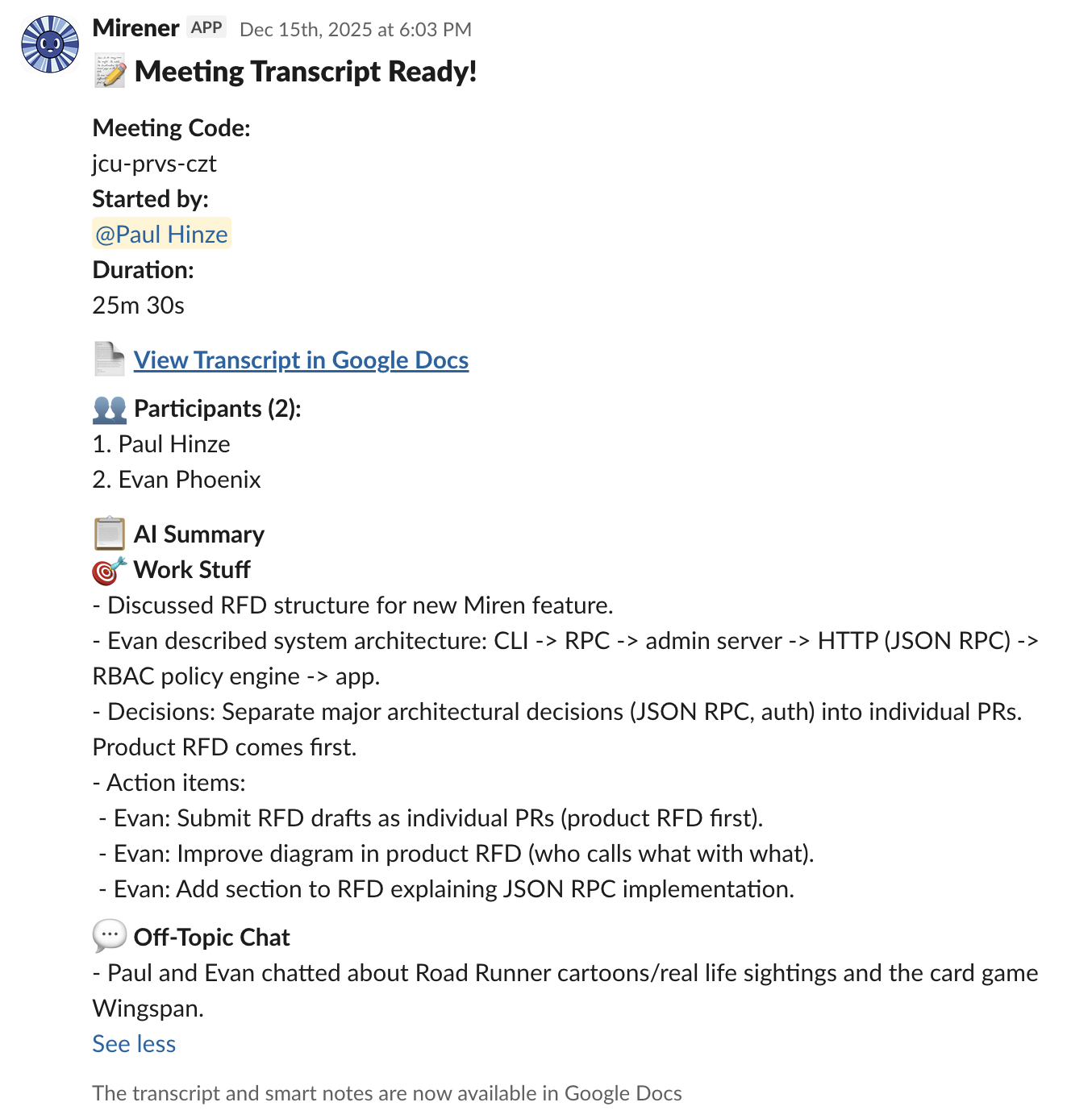
“What if we could see who’s in the meeting without joining?” Live participant lists. “What if we could search slackmojis and upload them right from Slack?” /emoji search. “What if we could see who’s around before starting a call?” Presence tracking.
None of it was planned. No roadmap, no sprint planning, no tickets. Someone would say “wouldn’t it be cool if…” and an hour later it was live.
Here’s the weird part: by treating this as a toy with low stakes, we ended up with something genuinely useful. We’ve been able to use Mirener to shape how we collaborate — we wanted it to be effortless to hop on a quick live chat, and to let the computers take notes so we could focus on the conversation. That’s exactly what happened.
What I Forgot
I’ve spent many years in environments where deploying anything requires a lot of ceremony. Heck, I’ve often been the person responsible for building that ceremony! The linters must OK, the tests must pass, the reviewers must approve. This stuff is all important and has its place — our core Miren services go through CI, which is the right call for customer-facing code.
But not everything needs that. Somewhere along the way I forgot how good it feels to just ship.
Mirener reminded me. The tools you choose reflect your values. The tools you build spread them.
Damn, I missed this. Enjoy the deploy.